Hey there, how’s it going with you?
I’m OK, thanks. It’s just been a rough few weeks with our one-year-old daughter Violet contracting Croup— an upper respiratory infection— and we’ve visited A & E twice, but she’s on the mend now, the poor thing. It’s horrible when a small child is ill. We are both pretty tired as well after disturbed sleep and lots of crying (mostly Violet’s).
Anyway, as we’ve been stuck inside a lot, I’ve got no adventures, big or small, to write about. I was going on an overnight bikepacking trip on Monday, but didn’t, of course.
In an effort to move on a bit from the fatigue I’ve been managing this last year, I’ve been wanting to summarise what’s been working for me, energy-wise, for a while now. Last night I got a few hours when Baby Violet was asleep and my energy was OK, so wrote this post.
Quick summary (sorry if you’ve read this a million times before)
I didn’t bounce back after my operation last year the way I’d hoped for. In fact, a form of long-term fatigue set in that saw me daily counting down the hours until I could go to bed, my brain in a fog, with hot flushes and my body often feeling coldy and flu-like.
Any attempt at running made me feel terrible for days, and I mourned the loss of my previous fit self and ability to compete in races.
These last 18 months have been a massive learning curve for me, and something I’ve worked pretty hard at. Cycling and yoga came to my rescue, and now I’m in a much better place.
So with my better energy and mental clarity, here are my top ten things I wish I could have told myself last year, in order to guide me through this long-term fatigue.
My Top 10 Fatigue vs Training Tips
- Be prepared to make tough decisions – if an activity/sport makes your fatigue worse, just stop it. Completely. Has it become part of your personality? Well, that’s tough, but it probably shouldn’t have been so central to your identity in the first place. No activity is worth three days of suffering afterwards.
- Overtraining can be mental too. Beware of doing too much analysis, too much planning for races you may not be able to do.
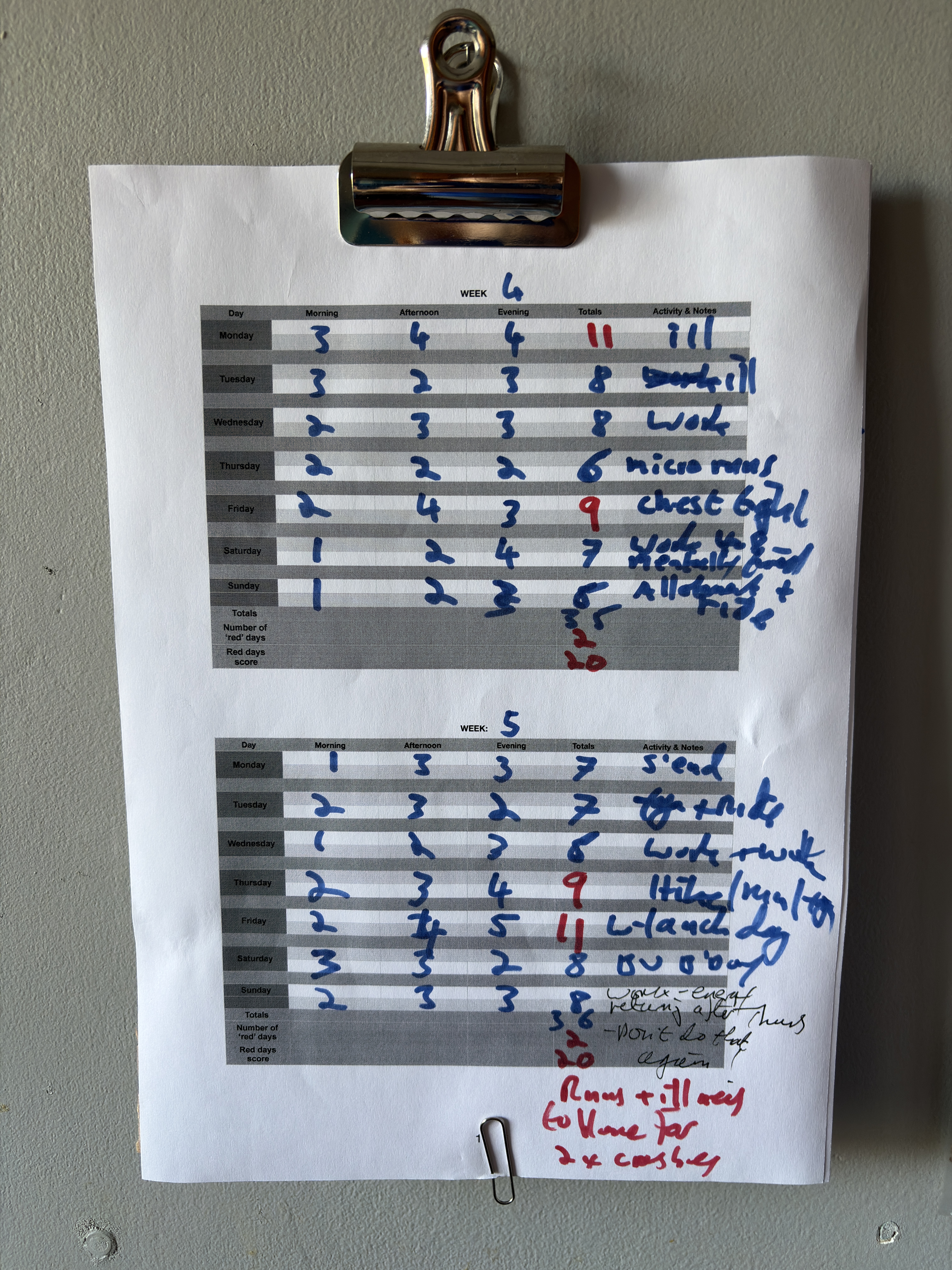
- Keeping a fatigue diary can be massively helpful in spotting fatigue causes and triggers and managing energy levels. I customised the sheet below from one I got from the Macmillan website HERE
- Think in terms not of training but of healing. Certain activities are healing, others are not. Certain environments are healing, others are not. Focus on the healing ones, stop the others.
- Eating well and regularly is obviously important. Make it good-quality food too, not just chips on the way home because you’re too tired and can’t be bothered to cook. Plan ahead.They do look good though, don’t they?
- Experiment with ways to regain some sense of control over your life. Like requesting 10-minute rest breaks at work every two hours. Like reducing overall hours to improve work/life balance. A small feeling of control goes a long way.
- Technology doesn’t really help. The tech revolution in wearable devices that promise to help you manage your health just hasn’t worked for me: For example, HRV hasn’t spotted my energy dips and my Sleep Score on my watch is generally high even though I often feel like shit upon waking. The lesson here is to develop an awareness of how you’re feeling within yourself. You are the best judge of that, not your watch.
- Energy needs to be viewed as a limited resource and shouldn’t be taken for granted. Be a bit more reserved in conversation, keep something back. Set and stick to boundaries. Avoid drama too, it’ll drain you. Also, pushing through a training session when you don’t feel up to it won’t result in progress and adaptations, it’ll simply make you feel terrible for days. Always keep something in the tank. Say no to things more often.
- Adventures don’t have to be epic, they can be local and holistic, not draining – see my last post HERE
- Accept the idea that perhaps an unknown percentage of this long-term fatigue thing could actually be a mental reaction to trauma, and not ‘simply’ a physical reaction to the operation. It may not be low iron or some other observable thing, or some magic training solution; there could perhaps be a mental aspect to it that needs acknowledging and addressing

So that’s it, ten tips to my previous self that illustrate my belief in the possibility of change.
Maybe this could be of help to others, I don’t know.
The good news is that because of all the above I’m finally feeling much better, with more energy available to get me through the days. I’m way less ‘trauma tired’ now, and ‘just’ baby tired instead, but I’ll take that any day.
Have I missed anything, do you think? Feel free to let me know.
 Tim Boat's Backyard & Beyond